 Crane Inspector Training & Certification — ABS Class Approved | API 2C + 2D | Practical on 40-Ton Crane
3-Day Intensive | API Spec 2C (7th Ed) + API RP 2D (7th Ed) | American Bureau of Shipping (ABS) Certified | On-Demand Corporate Booking
Elite Offshore Academy’s Crane Inspector Training & Certification is the only ABS Class-Approved offshore crane inspector course in India that includes practical training on a real 40-ton, 140-foot boom crane.
The course is designed around API Spec 2C 7th Edition 2012 (Offshore Pedestal-Mounted Cranes) and API Recommended Practice 2D 7th Edition 2014 (Operation and Maintenance of Offshore Cranes) — the two primary standards required for offshore crane inspection globally. On completion, delegates receive an official Crane Inspector Certification approved by the American Bureau of Shipping (ABS).
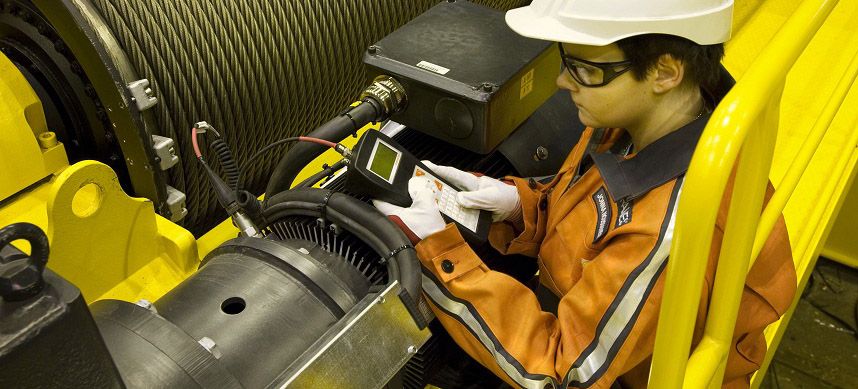
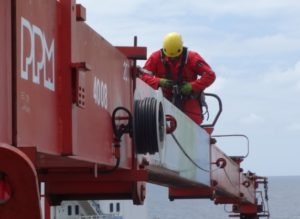
This course is conducted on an actual offshore crane — not a classroom model, not a simulator. Delegates practice identification of structural defects, wire rope wear, hydraulic system faults, load testing, and emergency procedures on the same type of equipment they will inspect in the field.
Available on demand for individual professionals and corporate groups (QA/QC teams, Third Party Inspection companies, Government inspection agencies, and offshore drilling contractors).
Key Facts
Fact | Detail | Why It Matters |
Approval | ABS (American Bureau of Shipping) Class Approved | World’s largest ship and offshore classification society — accepted by all major offshore operators |
Standards Covered | API Spec 2C 7th Edition 2012 + API RP 2D 7th Edition 2014 | Both primary API standards for offshore crane design, inspection, and operations — most competitors cover only one |
Practical Training | On actual 40-ton, 140-foot boom offshore pedestal crane | No simulator, no classroom models — real inspection on real equipment. No other India-based provider offers this. |
Duration | 3 days (11:00 – 18:00) | Intensive format — shorter than LEEA (4–5 days) without sacrificing content depth |
Assessment | Theory Test + Practical Test | Dual assessment ensures competency is demonstrated, not just memorised |
Scheduling | On Demand — no fixed batch dates | Book for your team whenever needed. Ideal for corporate shutdowns, mobilisation windows, HSE audits |
Target Sectors | Offshore oil & gas, QA/QC teams, Third Party Inspection (TPI), Government agencies, Construction | Not limited to offshore — any industry requiring API-standard crane inspection |
Fee | INR 75,000 per delegate (corporate rates available) | India-based ABS-approved training vs USD 2,000–3,000 for Dubai/Qatar alternatives |
Contact | +91-9699272855 (Call / WhatsApp) | Direct booking — no booking portals or queues |
Who Should Attend
Who Should Take the Crane Inspector Certification Course? The course is designed for professionals across multiple industries who are responsible for, or involved in, crane safety and inspection: QA/QC Personnel: Quality Assurance and Quality Control professionals at offshore drilling companies, construction firms, and manufacturing plants who oversee crane maintenance, inspection schedules, and regulatory compliance. Third Party Inspection (TPI) Companies: Independent inspection firms contracted to certify cranes on behalf of operators, insurance companies, and government bodies. ABS-approved certification adds recognized authority to TPI engineers’ credentials. Government Inspection Agencies: Officials from port authorities, maritime directorates, oil & gas ministries, and industrial safety agencies tasked with regulatory inspection of cranes at offshore platforms, ports, and industrial sites. Offshore Drilling Contractors and Operators: Rig superintendents, maintenance supervisors, and deck officers who need formal crane inspector qualification for their own rigs or to satisfy operator audit requirements. Crane Operators Seeking Career Advancement: Experienced crane operators (Stage 1–3) who wish to move into inspection, maintenance supervision, or QA/QC roles. DNV recommends 2 years of crane operator experience for their inspector course — our course has no fixed experience requirement. No Experience Prerequisites: Unlike LEEA (which requires a Foundation Certificate) or some API-U programs (which require prior API training), our course is open to any professional with a basic understanding of cranes who wishes to formalise their inspection competency. Contact us to discuss suitability. |
‘On-Demand’ Scheduling
On-Demand Scheduling: Book for Your Team The Crane Inspector course is available on demand — we do not run fixed monthly batches. This means: – Schedule around your team’s rotation, shutdown windows, or HSE audit calendar – Ideal for corporate groups of 2–10 delegates from the same company – Minimum 1 delegate — individual bookings also accepted – Course is confirmed within 5 working days of your enquiry – We provide the 40-ton crane and all training materials To book: Call or WhatsApp +91-9699272855 with your preferred dates and number of delegates. Our team will confirm availability within 24 hours. |
Crane Inspector Salary
Crane Inspector Salary in India (2026) Certified crane inspectors command premium day rates in the offshore oil and gas and industrial sectors: Offshore (India — ONGC, private drilling contractors): INR 8,000 – 15,000 per day Offshore (Middle East — UAE, Qatar, KSA): USD 400 – 700 per day (contract) Third Party Inspection (TPI) firms — India: INR 5,00,000 – 9,00,000 per year (salaried) Government inspection roles: INR 6,00,000 – 12,00,000 per year (Grade-dependent) ABS-approved certification significantly increases earning potential vs non-certified or informally trained inspectors. Many drilling contractors (Transocean, Valaris, Diamond Offshore, KCA Deutag) require API 2C/2D-based certification for their crane inspector rosters. |
FAQ
Q1. What does the Crane Inspector course cover?
A 3-day intensive programme covering API Spec 2C (crane design and construction) and API RP 2D (crane operations and maintenance). Classroom modules cover mechanical systems, hydraulics, electrical systems, NDE techniques, load charts, safety systems, and API design requirements. Practical sessions are conducted on a real 40-ton, 140-foot boom offshore pedestal crane — covering wire rope inspection, boom inspection, hoist systems, load testing, and emergency procedures. |
Q2. Who approves this crane inspector certification?
The course is approved by the American Bureau of Shipping (ABS) — one of the world’s largest and most respected maritime and offshore classification societies. ABS Class Approved certification is recognised by offshore operators, drilling contractors, QA/QC departments, and government inspection agencies globally. |
Q3. Is training conducted on a real crane?
Yes. Practical training is conducted on an actual 40-ton, 140-foot boom offshore pedestal crane. This is not a classroom model or simulator. Delegates practice identification of structural defects, hydraulic faults, wire rope wear, load testing procedures, and emergency load lowering on the same type of equipment they will inspect in the field. This is the most significant advantage over classroom-only or Dubai/Qatar-based competitor programmes. |
Q4. What is the difference between API 2C and API 2D?
API Spec 2C covers the design, manufacturing, and load rating of offshore pedestal-mounted cranes. It defines what a crane must be built to. API RP 2D covers the operation, inspection, and maintenance of offshore cranes — the operational standard that crane inspectors work to in the field. Most crane inspector courses cover only one of these. Elite Offshore Academy’s course covers both API 2C (7th Edition 2012) and API RP 2D (7th Edition 2014) in a single programme. |
Q5. Who should attend the Crane Inspector course?
QA/QC professionals, Third Party Inspection (TPI) engineers, Government inspection officials, offshore rig superintendents, maintenance supervisors, and crane operators seeking to advance into inspection roles. The course is also taken by companies wanting certified in-house inspection staff to reduce reliance on third-party inspectors. No prior certification is required. |
Q6. How much does a crane inspector earn in India?
Offshore India (ONGC, private contractors): INR 8,000–15,000 per day. Middle East contract roles: USD 400–700 per day. TPI firm salaried: INR 5–9 lakh per year. Government salaried: INR 6–12 lakh per year. ABS-approved certification and API 2C/2D training significantly increase earning potential over non-certified inspectors. |
Q7. How is the course scheduled?
The course is available on demand — there are no fixed monthly batch dates. You contact us with your preferred dates and number of delegates (individual or group), and we confirm availability within 24 hours. This makes the course ideal for corporate bookings tied to shutdown windows, HSE audit schedules, or crew rotation cycles. |
Q8. What are the prerequisites for the Crane Inspector course?
There are no formal experience prerequisites. The course is open to any professional who has a basic understanding of crane operations and is responsible for or interested in crane inspection. Unlike LEEA (which requires their Foundation Certificate) or some API-U programs, our course is accessible without prior certification. Some background in QA/QC, mechanical engineering, or crane operations is recommended. |
Q9. What certificate do I receive?
An official Crane Inspector Certification approved by the American Bureau of Shipping (ABS). This certification enables you to perform crane inspections for offshore and onshore applications in compliance with API Spec 2C and API RP 2D. ABS certification is verifiable and recognized by major offshore operators and EPC contractors globally. |
Q10. Can this course be run at our facility or offshore site?
Contact us to discuss onsite delivery options. For large corporate groups requiring training at a specific location, we can discuss mobilisation. Our standard course is conducted at our facility in Navi Mumbai on our 40-ton crane. Call or WhatsApp +91-9699272855 to discuss your requirements. |
Course Content
The crane inspector certification course is a mix of theoretical and practical crane inspection skills on an actual crane. At the end of the program, delegates will be assessed based on Theory Test and Practical Test. Course Content covers the entire body of information contained within API 2C & API 2D.
Class Room – API 2C requirement with respect to following on Crane design & construction: crane inspector
- Critical components;
- API 2C definitions;
- Crane rated loads;
- Crane ratings;
- Allowable stresses;
- Design authentication and testing;
- Critical rigging components;
- Boom hoist, load hoist and telescopic boom hoist;
- Swing mechanism;
- Power plant;
- Controls;
- Cabs and enclosures;
- Miscellaneous requirements and equipment;
- Welding of critically stressed components;
- Nondestructive examination of critical
Practical – Exercises in crane maintenance, troubleshooting and inspection centered on critical components of a crane using measuring and testing tools, identification of stress and corrosion as per below list:
A. Mechanical and non-mechanical cranes (basic general):
1) types of swing assemblies typically used on pedestal-mounted cranes;
2) crane safety systems;
3) wire rope;
4) prime mover;
5) boom inspection;
6) sheave;
7) load and pull test procedures;
8) emergency load lowering;
B. Non-mechanical (specific basic hydraulic):
1) hoist tear down and troubleshooting;
2) hoist brake test;
3) emergency load lowering;
C. Non-mechanical (specific basic Electric):
1) hook and swing board/panel voltage measurements;
2) emergency load lowering;
D. Mechanical (specific basic friction): crane inspector
1) clutches disassemble/reassemble and adjustments made;
2) boom band brakes adjustments;
3) control lever adjustments;
4) torqmatic converter pressure plate (clutch) adjustment;
5) emergency lowering;